
As passive investing becomes commoditised, systematic investing is emerging as the not-new, new engine for growth.
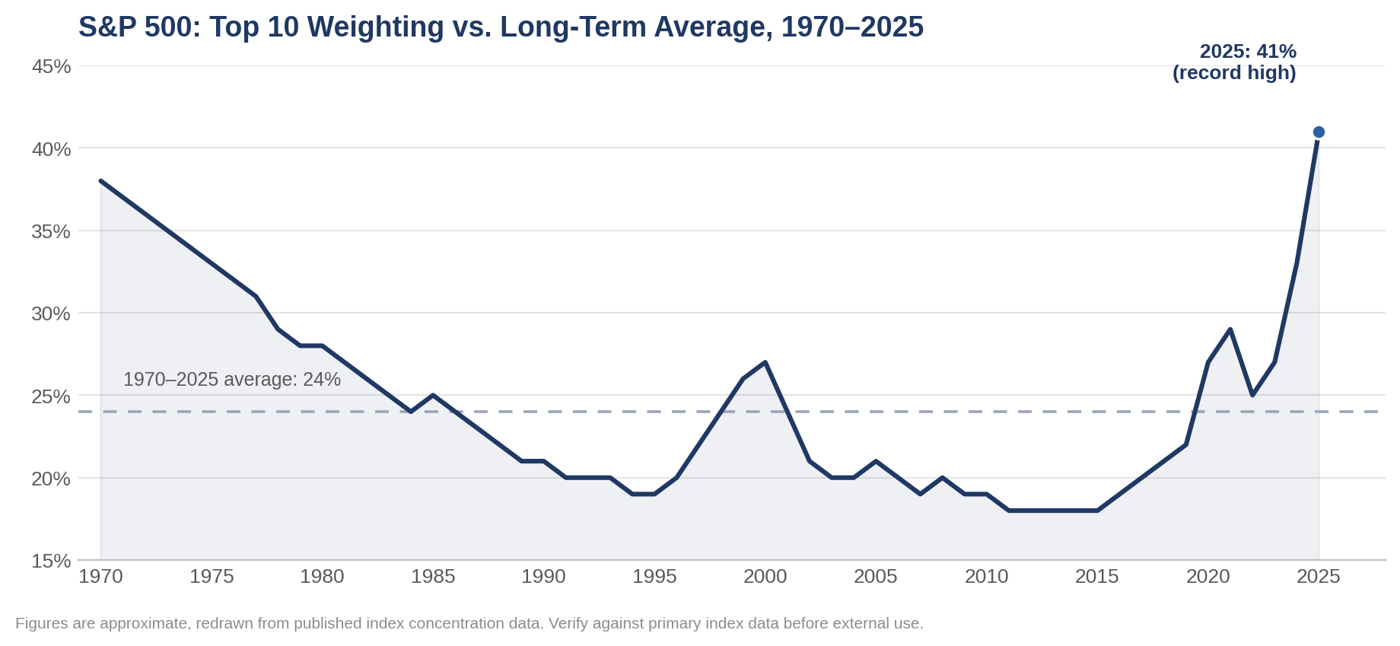
Two forces are reshaping equity markets right now: they are becoming more efficient, making consistent stock-picking harder, and the benchmarks passive funds track have become more concentrated than at any point in recent history. The top 10 names in the S&P 500 now make up roughly 40% of the index, more than double their share a decade ago.
Systematic, rules-based strategies aren't a new idea, but they are increasingly the answer to both problems at once: investment discipline without behavioural bias, and diversification away from an increasingly more concentrated market.
This note explains why this matters for portfolio construction, and how it shapes our Enhanced Passive Portfolio range.
1. Introduction
Passive investing has done its job. Low-cost, index-tracking exposure is now available to almost every investor, in almost every asset class, at a fraction of the cost it commanded a decade ago. In doing so, passive investing has become commoditised: a starting point rather than a source of differentiation.
Two structural forces are now reshaping what comes next. First, markets are becoming more efficient, making it progressively harder for discretionary stock-pickers to add value consistently. Second, the very benchmarks that passive funds track have become more concentrated than at any point in recent history, quietly reintroducing the single-stock risk that diversification was supposed to remove.
Systematic investing sits at the intersection of these two forces. It is not a new idea, its roots stretch back decades, but it is fast becoming the new engine of growth for portfolios that want to stay disciplined, diversified and cost-efficient in a market that increasingly rewards neither pure passive tracking nor pure active conviction alone. This note explains why.
2. From Passive to Systematic Investing
Passive investing’s rise was built on the efficient market hypothesis, the idea, developed in the 1960s, that share prices already reflect all available information and that consistently beating the market is therefore extremely difficult. This thinking underpinned decades of capital flowing out of expensive active funds and into low-cost index trackers, to the point that passively managed fund assets have now overtaken actively managed assets across major markets globally.
As passive products became standardised and fees compressed towards zero, asset managers looked for the next source of low-cost, repeatable returns. That search produced a natural progression: quantitative stock-selection models that screened companies on fundamentals as well as price, followed by smart beta strategies built around a single factor, and more recently multi-factor and machine learning-driven approaches that draw on far larger datasets than any individual manager could process. Artificial intelligence and natural language processing tools are now the latest step in that same evolution.
Definition: Systematic Investing
Systematic (or quantitative) investing is an evidence-based approach that uses data-driven, rules-based models, rather than discretionary judgement, to select and weight securities. It applies quantitative testing to validate investment ideas and seeks to harness persistent, well-documented drivers of return while keeping behavioural bias out of the process.
3. Why Now? Two Structural Drivers
The renewed interest in systematic strategies is not accidental. It reflects two developments that have become increasingly hard to ignore.
| Structural Driver | What is Happening | Implication for Investors |
| Markets becoming more efficient | More capital chasing fewer genuine mispricings, compressing the odds of consistent discretionary outperformance | A rules-based, repeatable process becomes more valuable than judgement calls |
| Rising index concentration | A handful of mega-cap names now dominate cap-weighted benchmarks to a degree rarely seen before | “Passive” exposure is no longer automatically diversified; systematic tilts can help rebalance this |
On the first point, active managers have found it harder to justify their fees. In recent Morningstar research, only around four in ten active funds beat their passive peers over a one-year period, continuing a long-run trend of declining success rates.
On the second point, the largest ten constituents of the S&P 500 now account for roughly 40% of the index’s total value, more than double their share a decade ago and above even the levels seen at the peak of the dot-com bubble. An investor holding a standard cap-weighted tracker is, whether they realise it or not, running a concentrated bet on a small number of mega-cap technology names. Systematic approaches, such as equal-weighting, factor-tilting or multi-factor screening, offer a rules-based way to dilute that concentration without abandoning the low-cost, transparent structure that makes passive investing attractive in the first place.
4. The Case for Systematic Investing
The advantages
Discipline: a systematic process follows an agreed set of rules consistently, removing the behavioural biases, such as holding on to losing positions for too long, that can affect even experienced investors, particularly during periods of market stress.
Scale: the volume of financial data now available far exceeds what any individual manager could process manually, and systematic models are built specifically to handle it.
Speed: systematic strategies can react to new information and rebalance far more quickly than a traditional research and decision-making process allows.
The risks
A note of caution: Systematic models are simplifications of the real world, calibrated on past behaviour. Markets evolve, and a model fitted too closely to history can struggle when conditions change structurally. Investors should also be wary of strategies described as a “black box”. A well-run systematic strategy should always be explainable, even the most complex machine learning models can be tested by examining how their outputs respond to different inputs.
5. How This Fits Our Model Portfolio Approach
This thinking sits directly behind our Enhanced Passive Portfolio range, covered in detail in our companion note, Active vs Enhanced Passive: What’s the Difference? By combining standard passive index funds with systematic, rules-based enhanced passive strategies, the portfolio seeks modest outperformance and reduced concentration risk, without the cost or complexity of full active management. Both our Active and Enhanced Passive ranges share the same strategic asset allocation and house macro views; what differs is implementation, with the Enhanced Passive range expressing those views systematically and broadly, keeping the portfolio closer to benchmark, lower cost, and less reliant on individual conviction calls.
6. Summary
In summary: As passive investing becomes commoditised, systematic investing is emerging as the not-new, new engine for growth: a disciplined, evidence-based response to markets that are simultaneously more efficient and more concentrated than at any point in recent history.
For investors, the message is straightforward: diversification can no longer be assumed simply because a fund is “passive”. It increasingly needs to be engineered.
If you would like to speak to us about this update, or to discuss our discretionary investment management services in general, please do not hesitate to get in touch.
DOWNLOADS
 Beyond Passive: The Rise of Systematic Investing